

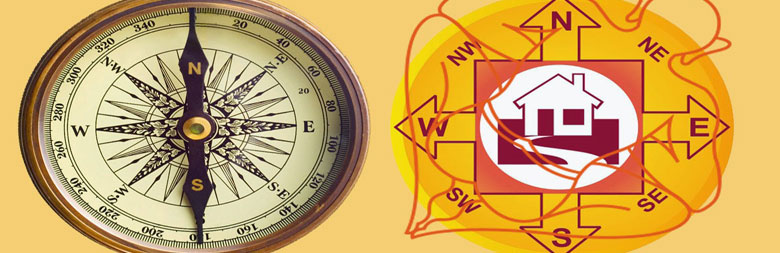
What is Vaastu Shastra?
A place where we live is called Vaas (वास) and is derived from Sanskrit root verb Vas (वस्, to live). The study of dwellings or houses is thus called Vaastu Shastra which is one of the branches of Darshanshastra. It is a way of living in harmony with the prevalent natural energies affecting the house like geomagnetic energy, solar energy, wind energy, lunar energy and energies received from all other cosmic bodies of the Universe. Basic purpose of Vaastu Shastra is to maximise the positive effects of these energies and minimise their negative effects. It is a way of life which suggests us how to live in our house in tune with the energy matrix of the Universe. The cosmic connection of Vaastu where we live, and its conformity with the subtle energies of Sun, Moon, Earth and all the celestial bodies of cosmos is by no means an abstract thing and this has been lucidly suggested in our ancient Vedic text; Atharva Veda which is the source text for all our knowledge and understandings about the procedures for everyday life. Sthapatya Veda is the Upa Veda of Atharva Veda which deals with planning, designing and construction of houses, villages and cities. Vaastu Shastra, the Indian science of Architecture finds its origin in Sthapatya Veda.
Another branch of Darshanshastra, Astrology is the study of the movements and relational effects of various planets on the human affairs and terrestrial events. The foundation of Astrology is the notion of bonding or connection between the microcosm and macrocosm. Therefore by aligning these two streams, the microcosmic connection of a place where we live and its interface with the subtle energies of Sun, Moon, Earth and all the celestial bodies of cosmos becomes clearly evident.This cosmic alignment of energies can be achieved by way of constructing and designing our houses on the principles laid down in our ancient Vedic texts. Structural modifications, plants, herbs, pyramids, colors, crystal balls, mirrors etc. serve the required purposes in the direction of rectifying and improving the cosmic alignment of an individual with respect to the place where he lives.
Therefore Vaastu Shastra not only prescribes detailed and complex guidelines for constructing a house for a joyful life, but it also suggests us how to lie in the bed for sound sleep; how to perform puja for maximum divine blessings; how to maintain cordial relations with our neighbours and relatives; how to sit in the office for better performance; how to ward off diseases, domestic quarrels and miseries; and how to purify and strengthen the aura of the house with the intelligent use of structural modifications and Vaastu catalysts for health, wealth and joy.
Have you ever noticed that?
- Defective wall clocks in house can attract problems concerning your servants and maids?
- Bad quality of window glass in the study room makes the children confused and under confident?
- Broken mirrors in the house are the reasons for bad health of the occupants?
- Creaking sound of the doors in a house can create havoc in the conjugal relations?
- Keeping brooms or garbage in the North-East corner is responsible for the domestic quarrels?
- Cracks in the walls can bring ill health to the family members?
- Wrongly placed almirah with a mirror attached to it can always leave you hard pressed for money?
- Toilet in the inappropriate direction is the reason for unemployment or failures of family members?
These are some of the vital diagnostic tools, to name a few, for any Vaastu expert during his visits to a house for addressing problems encountered by the inhabitants. These have been found to be equally relevant in cases of office premises, factories and other sites for diagnosing different problems faced by the occupants. Whole concept of Vaastu Shastra revolves around synergic distribution of different energies and five elements such as water, fire, earth, air and ether assigned to each corner North-East (Ishaan), South-East (Aagneya), South-West (Nairitya), North-West (Vaayavya) and Centre (Brahmasthan).
Vaastu as an organic body:
Vaastu, since ancient Vedic periods has been perceived as having consciousness of its own. That is why, we invoke Vaastu God in all our religious activities as an essential deity and offer prayers. It is not being treated as a structure in our Vedic rituals comprising only building materials like bricks, cement, steel and sand etc. rather it is being seen in Vaastu Shastra as a living organism in the form of a mythological entity Vaastu Purush with all the characteristics of a living human being which requires legs (pillars) to stand erect and move forward, eyes (windows) to see the outside world, nose (ventilators) to breath, brain (openness of North-East) to think and express its creativity and so on. That justifies the reason why according to Vaastu norms, the pillars and windows in the house have been prescribed to be in even numbers (symbolises the pairs); presence of useless nails on the walls amounts to pricking the body of Vaastu Purush and inflicting pains to it; and corrosions and cracks on the walls amount to the wounds of house.
Vaastu: A way of life
In order to have more acceptability in the predominantly Hindu society, it had been sanctified and associated with certain deities; such as North-East corner being the place for Lord Shiva, South direction being the place for Yama, God of death; East being the place for only living god Sun and so on. While doing so the boundary wall of each direction had been divided into nine equal parts and assigned to each God. Moreover, the open space between the boundaries and the house was assigned for the movements of Pishach (vampires) i.e., those imaginary entities which did not attain salvation (moksha) after their deaths. Any construction which connected the house with the boundary walls was thus strictly prohibited as per Vaastu norms for this reason only. This arrangement might have been suggested in Vaastu Shastra with a view to leave some open space between the house and the boundaries so as to have proper sunlight on the walls and free flow of winds for protecting it from the germs caused by humidity. We find it relevant in modern times also when we go for repairing the walls periodically. In this way our ancient saints in their absolute wisdom had consciously allocated respective places for Gods, vampires and human beings which was actually a reasonable way of energy distribution in the house.
Flow chart of energies in a Vaastu:
The flow chart of these energies in a house is in the shape of S, which enters from North-East, moves towards North-West and then South-East and moving out from the South-West corner. Another important aspect of this movement is its start in the entry point from the lowest level from the ground and in course of its movement towards South-West, it keeps rising. That is the most important factor why in Vaastu Shastra the height of the North-East wall is advised to be the lowest and the South-West wall to be the highest in a house. It is solely for the purpose of retaining those beneficial energies in the house.
Timeline of Vaastu effects:
It is interesting to note that the time taken for appearing the effects due to any alteration in the house, flat, factory or office follows a specific timeline. It is my personal experience that while any change in North-East corner takes almost one day to show the results, any such change in North-West corner takes around 35 to 40 days to give results. Alterations in South-East corner take almost six months to one year for their effects and any change in South-West corner can take more than one year for the effects to appear. Its benefit or harm depends upon whether such changes have been made according to the prescribed Vaastu norms or not. Though the effects of structural changes of all the directions and corners are of utmost importance in terms of their direct bearings on our health, wealth and happiness, we must take utmost precautions while making any change in North-East corner rather it is advisable to do it under the supervision of any Vaastu expert. It is for the simple reason that the effects are instant and significant and because other changes can be rectified or undone in case of any unexplained complications due to sufficient time.
It has been scientifically established that a building whether home, office or factory having its own life force energy level and aptly measured and demonstrated by a French archaeologist-physicist Anton Bovis. While doing research on pyramids, he found a unique energy pattern present in the vicinity of such structures. It was later on demonstrated with illustrations that for all animate as well as inanimate objects, there was unique life force energy. For living organisms, this life force energy had been measured as 6500 Bovis (named after him) whereas the desired minimal energy level for a human being in order to sustain was found in between 8000 to 10000 Bovis. Earth’s energy level was found to be in the range of 7000 to 18000 Bovis. We have also felt in several cases, that living in a premise for longer duration having lower life force energy drain our natural energy level thereby resulting in perpetual state of unrest, irritability and fatigue caused as a result of prevalent Geopathic stress in the campus.
What happens in a non Vaastu compliant house?
Our each action has a defined set of norms and principles to follow. Whether eating, drinking, driving, studying, and dressing, everything requires a discipline and well established method. We cannot wear shoes on the head and the hat in the feet. Apart from looking absurd, it does not serve even its own purpose of being. Likewise once we deviate from the predefined set of rules made by the Government or any natural law, we face difficulties and thereby inflicting pains on ourselves. Similarly, in the case of constructing a house or staying in a house already constructed, when we deviate from the architectural or engineering disciplines, we face the ill effects caused by such deviations. If nature is kind enough to fulfill our essential requirements of life free of cost such as air, water, sunlight, moon light etc. It is equally ruthless when we disobey these principles. Likewise, living in a house also requires certain rules to be followed by us in order to reap the benefits of the energy matrix of that house. Although any defect in the house is not the only reason for any particular inauspicious result. It is the cumulative effect of other defects as well. The problems faced by the occupants significantly hint at the primary Vaastu defects of the house.When we do not follow those Vaastu principles then every aspect of our day to day activity is adversely affected and we experience all kinds of problems. These problems can be in the form of health diseases, financial distress, relational stress, workplace hazards and even untimely death of family members. On the other hand, a building constructed as per Vaastu norms can invoke divine energy reflected as health, wealth and joy for the family members.