

Feng Shui, a Chinese way of harmonizing individuals with the surrounding environment by taking the help of some metaphors is one of the Five Arts of Chinese Metaphysics. It emphasizes on the existence of invisible force Chi which binds the individual with earth and the universe. Chinese reliance on Five Elements as the forces essential to human life in order to balance two poles Yin and Yang in a house or city is the core of Feng Shui. Evidence for its effectiveness is based primarily upon anecdotes and users are often offered conflicting advices from different practitioners.
Actually there is a divergence also between the practitioners from Northern Hemisphere and Southern Hemisphere. The differences between the two hemispheres are a fact of reality. Speaking in geographical coordinates, the equator acts as a mirror dividing Earth into two hemispheres north and south. In the Northern Hemisphere cold is in the north-the Arctic whereas in Southern Hemisphere it is in the south Antarctica. The seasons also are different in both the hemispheres. So the principles of Feng Shui need to be customized in each hemisphere.
China is a large country famous worldwide for its Great Wall of China .What necessitated the construction of the Great Wall was not any religious compulsion. The main purposes for construction of the Great Wall were to protect Chinese territories and empires primarily from tribal invasions from Mongolia and Siberian winds coming from North in winter. These two compulsive circumstances were the major factors forcing them to construct the Great Wall in the North albeit part by part in many centuries. So actually they were forced to construct the Great Wall in the North and fencing their borders for the protection of their territories because of the geographical necessities.
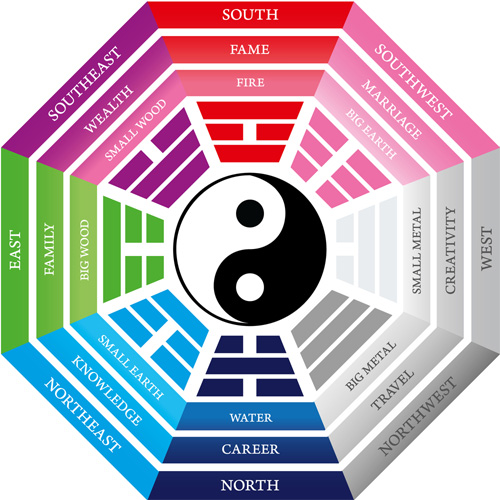
An interesting difference between the two streams of Vaastu of ancient India and China can be seen in terms of their perceptions of North direction. While ancient Indian Vaastu Shastra considers this direction as an auspicious direction ruled by planet Mercury and thus prescribing the direction for doing virtuous acts, Chinese on the other hand, perceived this corner as bad purely for their own geographical necessities. They have used several anecdotes and metaphors for all the directions dominated by certain animals and creatures generally found in their areas and devised unique set of corrective measures for the corresponding directional defects. So a major discrepancy is evident while dealing with the Vaastu corrections made on the basis of Feng Shui principles. For example; the pictures of dragon or any animal placing in the North- East direction is essentially a remedy for the defects of North-East corner, whereas we follow the same remedies for the same direction without understanding the fundamental precepts of Feng Shui, thereby adding more problems in life. So without the guidance and supervision of a Feng Shui expert and without customization, we should not try the remedial measures as prescribed in Feng Shui. It is always better to go for the Vaastu corrections according to our own beliefs and mythological understandings rather than applying the same from an unknown source. The belief system of every culture and civilization is unique and essentially a reflection of its own cultural heritage and geographical necessities.
In so far as the remedial measures prescribed in this system are concerned, few remedies have been proved to be effective in our system as well. For example; the uses of Mirror, Crystal Ball, Pa Kua mirrors, Wind Chimes, Laughing Buddha, Candles as prescribed by this system for Vaastu corrections have to be understood well with their underlying principles and only then they should be applied in our own contexts for the remedial purposes.