


Our ancient Vedic text, Atharva Veda is the source text for all our knowledge and understandings about the procedures for everyday life. Sthapatya Veda is the Upa Veda of Atharva Veda which deals with planning, designing and construction of houses, villages and cities. Vaastu Shastra, the Indian science of Architecture finds its origin in Sthapatya Veda. Astrology is the study of the movements and relational effects of various planets on the human affairs and terrestrial events. The foundation of Astrology is the notion of bonding or connection between the microcosm and macrocosm. Therefore by aligning these two streams, the microcosmic connection of a place where we live and its interface with the subtle energies of Sun, Moon, Earth and all the celestial bodies of cosmos is by no means an abstract thing.
In ancient Vedic texts on Vaastu Shastra and even in Astrology, the Sun, king of solar system and the Moon, satellite of Earth both have been treated as planets and even shadow planets Rahu and Ketu also have been treated as planets. Therefore we find in Vaastu Shastra that all these planets represent particular directions and every direction is ruled by a particular planet; for instance Jupiter is the ruling planet for North-East, Sun is for East, Venus is for South-East, Mars is for South, Rahu is for South-West, Saturn is for West, Moon is for North-West and Mercury is for North. The place of shadow planet Ketu has been assigned by some texts in North-West, whereas some texts have assigned North-East as a place for Ketu. In astrology, this shadow planet Ketu is known as a planet responsible for enlightenment and emancipation (moksha). Lord of North-West in astrology is the planet Moon governing our minds, and Jupiter being the lord of North-East is a planet signifying our knowledge and wisdom. Enlightenment is closer to knowledge than mind and hence in my view, Ketu can be said to occupy it’s place with Jupiter in North-East corner.
For a proper understanding of Vaastu of an individual with reference to Astrology, it is important to know that the Ascendant (lagna) of the natal chart of an individual is taken as East direction of his house and similarly 4th house signifies North, 7th house is West and the 10th house is considered to be the South direction of the house. Similarly 2nd and 3rd houses correspond to North-East (Ishaan), 5th and 6th houses are for North-West ( vayavya), 8thand 9th houses are for South-West (Nairitya) and lastly 11th and 12th houses correspond to the South-East ( Aagnyeya) directions. Kitchen which should be in South-East direction according to ancient Vaastu Shastra is represented by Venus. Placement of Venus in 12th house is the only position where this is exalted as per Astrology. It shows that Vaastu Shastra and Astrology both are fundamentally in conformity with each other.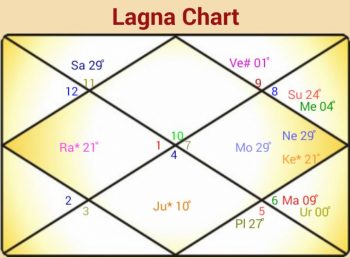
During one of the Vaastu visits and analysis of the natal birth chart of the native, it was found that the ruler of 3rd house Pieces i.e. Jupiter was in Cancer, which means the ruler of North-East Jupiter was itself exalted. It was reflected in the corresponding Vaastu design of the house as well. The house in discussion here had wide open and extended North-East with water body in that zone and plantations in conformity with the principles of environmental Vaastu. Even the placement of Jupiter in 7th house having direct Graha drishti on the Ascendant itself was sufficient to indicate a qualitatively good east. This was supported actually by having open East direction of the house making it affluent in solar energy. The above Lagna chart can be a good example of showing an inextricable connection between Vaastu and Astrology.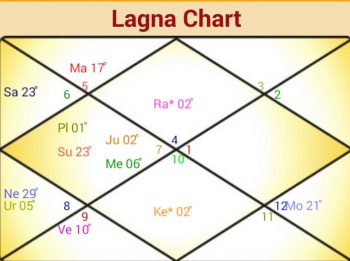
Another case was analysed where Rahu was in ascendant in the native’s birth chart which is shown above. Rahu in Ascendant generally gives good results, if placed in good sign. But the placement of Rahu in Cancer Ascendant which is the enemy sign for Rahu makes an inauspicious planetary combination. It also suggests the likelihood of mental problems such as depression or mania for the native. This was further supported by the placement of Sun, lord of East in the enemy Rashi Libra where Sun itself is debilitated. These both hinted at a serious defect in East direction of the native’s flat, which was in reality deficient in solar energy because of absence of windows and presence of lift in the East.
Vaastu arrangements of a house changes in due course after the master of the house dies and the same is inherited by his eldest son. The Vaastu defect of earlier period gets altered either knowingly or unknowingly by son if his own astrological birth chart is different from that house. Cases have been found that the Vaastu design of same house changes according to the natal horoscope of the next owner. Even the disease, which the father was suffering from (as a result of particular Vaastu defect), before his death gets inherited by the next generation until that defect is rectified somehow. Same applies in the case of the death of mother, which is inherited by the next generation eldest female of the family, particularly wife of the eldest son. Not only the health aspect but the effects on all the houses of natal birth chart of a native can be precisely analysed and compared with the respective Vaastu of the native and suitably rectified if it is required.
From astrological point of view also, the exal tation or debilitation of any planet in the natal chart of an individual is clearly reflected in the strengths and defects of respective cardinal directions or corners in his house. He can accordingly reap the maximum benefits or face the hardships associated with those planets during the period of his Vimshottari Dasha and planetary transits. Therefore one can significantly reconfigure his destiny with the Karmic interventions in his house by way of applying effective remedial measures for those Vaastu defects. What is more interesting is the fact that a good Vaastu is like an umbrella which protects us in case of rough planetary weather whereas a bad Vaastu has the leg pulling effects for the expected progression despite a brilliant and beneficial planetary phase.
Planets and their positions in Vaastu:
According to ancient Vaastu Shastra and even in Vedic Astrology, the king of Solar system Sun and the natural satellite of Earth i.e. Moon, both have also been classified as planets. Therefore in Vaastu Shastra, all these seven planets along with shadow planets Rahu and Ketu have been assigned the ruler ships of either a particular direction or a corner of a house.
North-East (Ishaan) — Jupiter
East — Sun
South-East (Aagneya) – Venus
South —— Mars
South-West (Nairitya) – Rahu
West —— Saturn
North-West (Vaayavya) – Moon
North —– Mercury
North-East ——– Ketu
Place of shadow planet Ketu has been assigned North-West by some texts whereas some others have given North-East as a place for Ketu. Before assigning any place for Ketu, first we should discuss what it stands for. Ketu has been considered as a Moksha karak grah (planet for enlightenment and emancipation) in Vedic Astrology. Enlightenment is closer to knowledge and wisdom as represented by Jupiter rather than to mind which is represented by Moon. Moreover Rahu and Ketu are North node and South node respectively and they are said to be just opposite to each other. By applying this logic also, Ketu should be placed in North-East corner opposite to Rahu which is assigned South-West corner. A careful thought on these aspects can lead us to take a view that Ketu should have a place with Jupiter in North-East corner rather than with Moon in North-West corner. Mutual relationships or afflictions of all these planets represented by structures, objects and significations have substantial impact on the occupants of the house.